
WhatsApp is about to start charging you for replying to your customers. Honestly? Good.
From 1 October, the free window closes. Here is exactly what changes, what it will actually cost you, and why I think it will make most businesses better at this, not poorer.
I have had three versions of the same conversation in the last fortnight.
A client sees a headline about Meta changing WhatsApp pricing, forwards it to me with a row of question marks, and asks whether they should press pause on the whole thing.
So let me deal with it properly, in one place. What is changing, who it actually affects, what the numbers look like when you sit down and work them out, and why I think the businesses who take five minutes to understand this now will end up better off than the ones who quietly back away from it.
Short version: the free ride is ending, the cost is smaller than you think, and the change will probably make your WhatsApp work harder.
FIRST, THE FACTS. WHAT ACTUALLY CHANGES FOR WHATSAPP ON 1 OCTOBER?
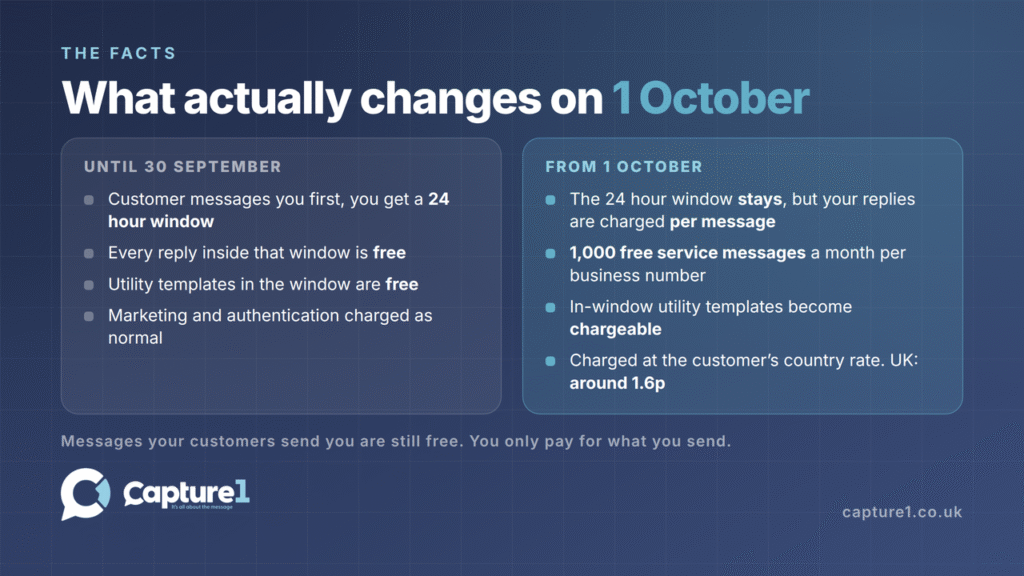
Right now, when a customer messages you first, you get a 24 hour window to reply. Anything you send inside that window is free. Human replies, bot replies, all of it. Utility templates inside that window are free too. Meta has effectively been subsidising business conversations on WhatsApp for a couple of years.
From 1 October 2026, that stops.
What is changing
Service messages (your free-form replies inside the 24 hour window, whether a person or a bot sends them) become chargeable per message.
Every business phone number gets 1,000 free service messages a month. Billing starts at message 1,001. The allowance resets monthly and does not roll over.
Utility template messages sent inside an open window also become chargeable. They used to be free in there.
Service messages are charged at the utility rate for the country your customer is in, not the country you are in.
There are no volume discounts on service messages, unlike utility and authentication.
What is not changing
Messages your customers send you are still free. You are only charged for what you send.
Marketing and authentication messages carry on exactly as they do now.
Conversations that start from a Click to WhatsApp ad or a Facebook page message button still get their free 72 hour entry point window.
The free WhatsApp Business app on your phone is completely unaffected. More on that in a second, because this is where most of the confusion sits.
In the UK, the utility rate is around 1.6p a message. So that is the number to hold in your head for every reply you send once your free 1,000 are used u
"DOES THIS EVEN AFFECT ME?" THE BUSINESS APP VS THE API
This is the bit worth reading twice, because a lot of people are panicking about a change that does not apply to them, and a few people who should be paying attention are not.
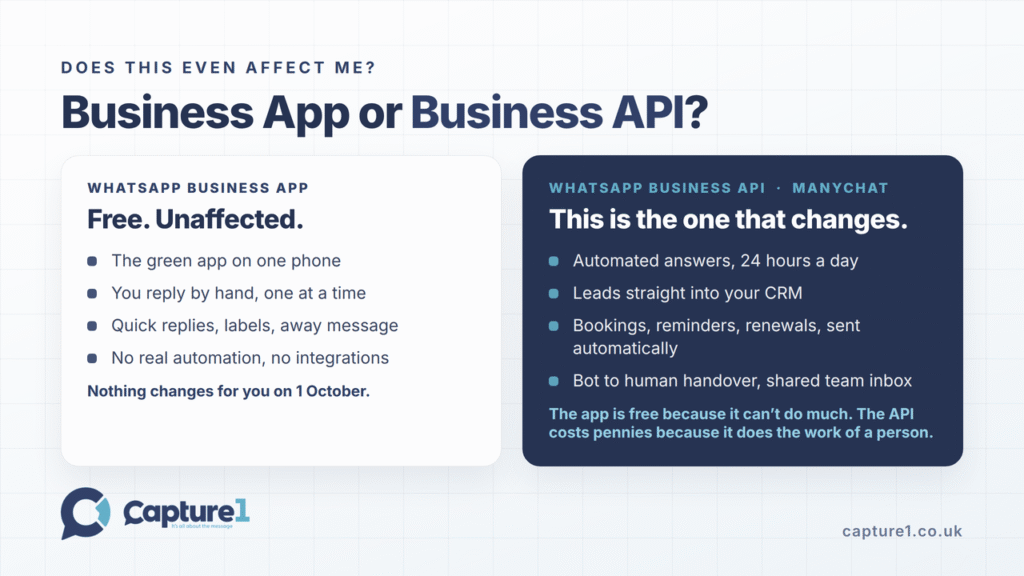
The WhatsApp Business app is the free green app you download onto a phone. You reply by hand, one message at a time. You get quick replies, labels and a basic away message. Nothing here is changing. It stays free. If that is how you run WhatsApp, you can stop worrying and carry on.
The catch has always been that it does not scale. One phone, one person tapping. No automation worth the name, no proper integration with your booking system or CRM, and no way for five people to work the same inbox without chaos.
The WhatsApp Business API is the version we build on for clients, usually through ManyChat. There is no app to open. Your WhatsApp connects to a platform that can send, receive, route, tag and automate at volume. That is what makes it possible to:
- Answer the 40 questions you get asked every week, instantly, at 11pm, without anyone being awake
- Qualify a lead and drop it straight into your CRM.
- Send a booking confirmation, a reminder, an event schedule or a renewal nudge automatically
- Hand a live conversation from the bot to a real human on your team, mid chat, without the customer noticing a join
- Run five team members through one shared inbox on their own phones
The pricing change applies to the API. Not the app. If you work with us, or with any agency running ManyChat or a similar platform, this is your change.
And to be blunt about the trade off: the app is free because it cannot do very much. The API costs pennies because it does the work of a person.
WHAT IT ACTUALLY COSTS. LET US DO THE MATHS
Numbers beat adjectives, so here is a realistic example.
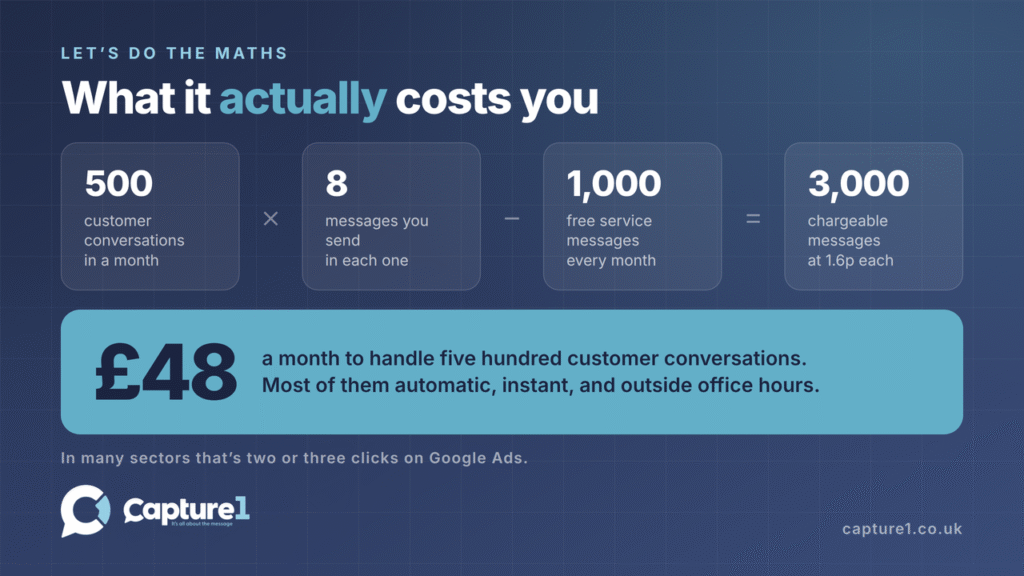
Say a customer messages you, and over the course of a conversation you send eight messages back. Answers, options, a confirmation, a follow up. That whole conversation costs you about 13p. Their messages cost you nothing.
Now scale it. Say you handle 500 of those conversations in a month. That is 4,000 messages from you. The first 1,000 are free, so you are paying for 3,000.
3,000 x 1.6p = 48 pounds a month.
Forty eight pounds to handle five hundred customer conversations, most of them automatically, most of them instantly, most of them outside office hours.
Sit that next to what else 48 pounds buys you. In a lot of sectors it is two or three clicks on Google Ads. It is a fraction of an hour of someone’s time answering the phone. It is less than most businesses spend on coffee for the office in a week.
I am not saying the cost is nothing, and if you are running very high volumes with long, waffly flows, it will be a real line on your budget. That is exactly why the design of your flows now matters. But for most businesses the number that comes out of this exercise is smaller than the fear that went into it.
WHAT THIS MEANS FOR YOU IN PRACTICE
Three things change in the way you should think about your messaging.
- Length is now a cost. Every extra message you send has a price on it. A flow that takes nine messages to get someone booked in costs more than one that takes four. So the sprawling, over branched flows with a message for every eventuality are now genuinely more expensive than a tight, menu driven path that gets someone where they are going. Good news, honestly. Those short flows always converted better anyway.
- Resolution beats reply count. The old measure was “did we reply?” The new one is “did we sort it, and in how few messages?” That is a much better thing to be optimising for, and your customers will feel the difference.
- Your first 1,000 are free, so small operations may notice nothing at all. If you are handling a few hundred conversations a month, you may sit inside the free tier and never see a bill. Worth checking your own numbers before you assume anything.
NOW THE PART NOBODY SAYS OUT LOUD. THIS IS QUITE A GOOD THING
I know how that sounds coming from someone who sells WhatsApp for a living. Hear me out.
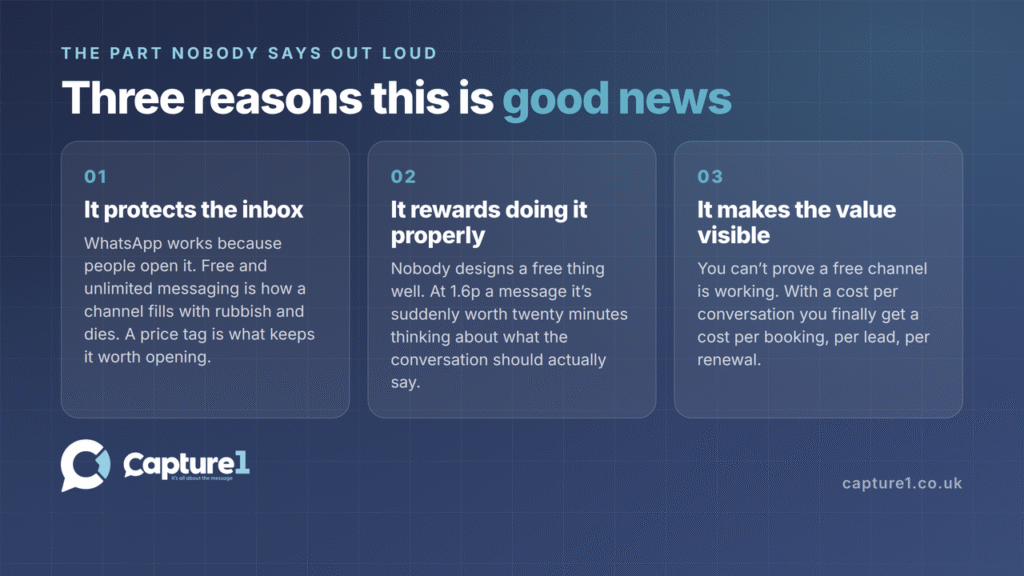
It cleans up the channel. The reason WhatsApp works so well is that people actually open it. Open rates north of 90 per cent, replies in minutes rather than days, no spam folder. That only holds while the inbox stays worth opening. The moment messaging becomes free and unlimited, it fills with rubbish, people mute businesses, and the channel dies. Meta putting a price on it is what protects the thing that makes it valuable in the first place.
It rewards businesses who do it properly. When something is free, nobody bothers to design it well. When it costs 1.6p a message, suddenly it is worth 20 minutes of thinking about what the conversation should actually say. The businesses who put that thinking in will get better results, and they will be competing against a smaller field, because a chunk of their competitors will read a headline and back away.
It makes the value visible. Here is the thing about free channels: you cannot prove they are working, because there is nothing to measure them against. The moment there is a cost per conversation, you can put a number on your cost per booking, your cost per lead, your cost per renewal. That is when messaging stops being “something we do” and starts being a channel you can defend at a board meeting.
A QUICK WORD ON NEW COSTS, FROM SOMEONE WHO HAS WATCHED BUSINESSES GET THIS WRONG FOR 25 YEARS
There is a reflex a lot of businesses have when a new charge lands. Cut it. Pause it. Wait and see.
I understand it, but it is usually the wrong instinct, and here is why.
Spending nothing and getting nothing is not saving money. It is just a slower way of losing it. Every business I have watched grow properly has been comfortable with the idea that money goes out in order for more money to come back in. The question was never “does this cost something?” It was always “does it bring back more than it costs?”
So the right response to 1 October is not “how do we avoid this cost?” It is “what is a customer conversation worth to us, and does 13p sit comfortably underneath that?”
For nearly everyone I work with, the answer is not close. A gym membership, a hotel booking, an event ticket, a treatment, a stand at a trade show. If a handful of pence in messaging brings one of those over the line, the maths is not difficult.
The businesses that get hurt by pricing changes are the ones who never knew what their channel was earning them. The ones who do know just adjust and carry on.
WHY THIS SHOULD PUSH YOU TOWARDS WHATSAPP, NOT AWAY FROM IT
Step back from the pennies for a second.
Email open rates sit somewhere around 20 per cent on a good day. SMS costs more per message than this does and gives you no conversation, no buttons, no media, no automation worth the name. Phone calls need a human being on the end of them, and that human costs considerably more than 1.6p a message. Live chat on your website only works while somebody is sitting on your website.
WhatsApp gets opened, gets read, gets replied to, and now costs roughly the same as it always should have. Even after 1 October it remains, by a distance, the cheapest way to have a real two way conversation with a customer at scale.
Nothing about this change makes WhatsApp a worse channel. It just moves it from “free and therefore slightly unserious” to “cheap and properly accountable”. I would take the second one every time.
FIVE THINGS WORTH DOING BEFORE 1 OCTOBER
- Find out which one you are on. App or API. If you do not know, ask whoever set it up. It changes everything about whether this affects you.
- Count your monthly outbound messages. You may well be under 1,000 and worrying about nothing.
- Look at your longest flow and count the messages. If it takes more than five to get someone to an outcome, there is money sat in that flow.
- Check what is classed as marketing and what is classed as utility. A lot of nudge and reminder templates are still classed as marketing, which carries a higher rate. Worth reviewing rather than assuming.
- Work out what a conversation is worth to you. Average order value, conversion rate, done. You cannot make a sensible decision about a 1.6p cost without it.
WHERE WE COME IN
This is the point where I should tell you that you need an agency. What I will actually say is a bit narrower than that.
You do not need us to send a WhatsApp message. You might need us to make sure the ones you send are earning their keep.
Most of what we do at Capture 1 is not the building. The building is the easy part. It is the thinking that goes in front of it. What the conversation should actually achieve. Which questions are worth automating and which genuinely need a person. Where the handover from bot to human should sit. How the flow gets someone to an outcome in four messages instead of nine. What you should be measuring so you can see, clearly, whether this channel is making you money.
Then we build it, connect it to whatever else you are running, and keep an eye on the numbers so the costs stay where they should be and the returns keep climbing.
We have been doing chat and messaging for clients across events, hospitality, leisure, attractions and membership for years now, and the pattern is the same every time. The businesses who treat WhatsApp as a proper channel with a proper strategy get results that make the message costs look silly. The ones who bolt a bot on and hope tend to conclude that it does not work.
The pricing change does not alter that. It just makes the gap between the two more obvious.
——————————————————————————–
If you have got WhatsApp running and you are not sure what 1 October means for your numbers, send me a message. I will happily run the maths with you, whether or not there is anything in it for us. It usually takes about fifteen minutes and people generally feel a lot better afterwards.
So, what would a customer conversation have to cost before you would think twice about having one?
Helen Nurse is the founder of Capture 1, a UK agency specialising in WhatsApp Business API, chat marketing and messaging automation. Known to some as The WhatsApp Woman, mostly by people who have heard her talk about open rates at a trade show.